MapQuest: Get Directions
- 4.4
- Rating
- 10.00M
- Installs
- Free
- Price

 Analysis by App-foxy
I usually judge a navigation app by one simple question: can I get from installing it to a useful route without feeling lost myself? MapQuest: Get Directions makes a straightforward first impression. It is a free maps and navigation app from MapQuest, built around route planning, GPS guidance, voice directions, and traffic information. I found it most useful when I wanted a familiar driving tool without committing to a paid navigation service.
The app has been available since February 15, 2011, and its long presence explains why it feels like a traditional mapping product rather than a social travel platform. It has passed ten million installs, carries an average rating of 3.3 from roughly sixty-eight thousand ratings, and has about twenty-one thousand written reviews. Those figures suggest a large, mixed audience: plenty of people find it practical, while others clearly run into issues depending on their phone, location, or expectations.
Getting from installation to a first useful route
I start this section with a low-pressure test: choose a destination I know well, check that the address points to the right place, and look over the route before setting off. That first run helps me judge whether the map and spoken prompts suit my driving habits, without making an unfamiliar trip the test case. Once the basics feel comfortable, I can look more closely at what to expect when opening the app.
You May Also Like

 Blood Strike: 2.5 Anniversary
Blood Strike’s Loadouts Turn Every Drop Into a Tactical Gamble
A close look at Blood Strike’s custom loadouts: how fast access to signature weapons reshapes its battle royale rhythm, rewards preparation, and narrows the gap between fights.

 Pandora - Music & Podcasts
Pandora’s Music Is Easy to Start, but Harder to Recover
Pandora’s strength is its low-effort path from a seed to a station. Its weak spot is how much confidence it asks you to place in connection, setup, and quiet recovery.

 8 Ball Pool
 Is Built on Rivalries, Rematches, and Routine
A close look at the rivalries, rematches, shared routines, and unanswered safety questions that turn a quick pool match into a persistent mobile community.

 Samsung Music
’s Quiet Strength Is Playing What You Already Own
Its reach comes less from spectacle than from dependable access to a personal library. That simplicity is both the app’s strongest retention engine and its ceiling.

 AccuWeather: Weather Radar
AccuWeather Review: A Quick, Clear Forecast for Everyday Decisions
For everyday plans, the best forecast is the one you can understand quickly. AccuWeather makes rain timing, radar, and local conditions easy to act on, with a few trade-offs.

 Hill Climb Racing
Why Hill Climb Racing Still Turns Crashes Into One More Run
A tiny car, a bumpy hill and one more upgrade: Hill Climb Racing keeps resurfacing because its simple chaos makes every near-miss feel personal.
More From Our News Desk



What to expect when you open it
My first recommendation is to treat MapQuest as a focused driving companion, not as an all-purpose travel planner. Its strongest identity is getting you from one place to another with map guidance, spoken instructions, and traffic awareness. That makes it a natural fit for commuting, errands, road trips, and checking a route before leaving home.
The interface is easier to understand when you begin with a specific destination instead of exploring every option. Enter an address, business, landmark, or other recognizable place, then inspect the proposed route before starting navigation. This small pause matters. A route that looks sensible on a map may use a road you would rather avoid, pass through a busy area, or take you away from the direction you intended.
I also like that the app can serve two different purposes. You can use it actively while driving, with voice guidance helping you keep your eyes on the road, or use it before departure as a planning screen. For a short trip, the second use is often enough: check the estimated path, notice major turns, and leave with a better idea of what to expect.
The free price makes trying it low-risk, although the app includes optional in-app purchases priced between $1.99 and $4.99 per item. I would not install it assuming every possible extra is included without checking the relevant screen. The core appeal is the basic navigation experience, while optional purchases may matter only to users who want additional convenience.
First setup without overcomplicating things
After installing, I would begin by confirming that the app can determine your position and by entering a destination you already know. A familiar journey is the best test because you can notice whether the map places you correctly, whether the route makes sense, and whether spoken instructions arrive at useful moments.
MapQuest supports Android devices running version 7.0 or later. That is helpful for people using older phones, but compatibility alone does not guarantee a smooth experience. Navigation can be demanding on a phone, especially when the screen is bright, the device is warm, or several other apps are active. Before a long drive, I close anything unnecessary and make sure the phone is mounted where I can see it without reaching down.
One practical habit is to type the complete destination rather than relying on a vague business name. A shop or restaurant may have multiple locations, and selecting the wrong result can create a perfectly accurate route to the wrong place. I check the displayed address and surrounding streets before pressing the button to begin guidance.
Another useful habit is to plan while stationary. I enter the destination before pulling away, review the route, and only then start driving. This is not merely a safety preference; it also gives the app time to settle on the correct starting position. If the blue location marker appears on a nearby parallel road or in a parking area, I wait until the map reflects where I am actually leaving from.
The first successful action
A first meaningful success with MapQuest is not simply seeing a line drawn between two points. It is completing a short drive while understanding what the app is telling you. I suggest choosing a familiar destination about ten or fifteen minutes away, starting the route, and listening for the first few instructions.
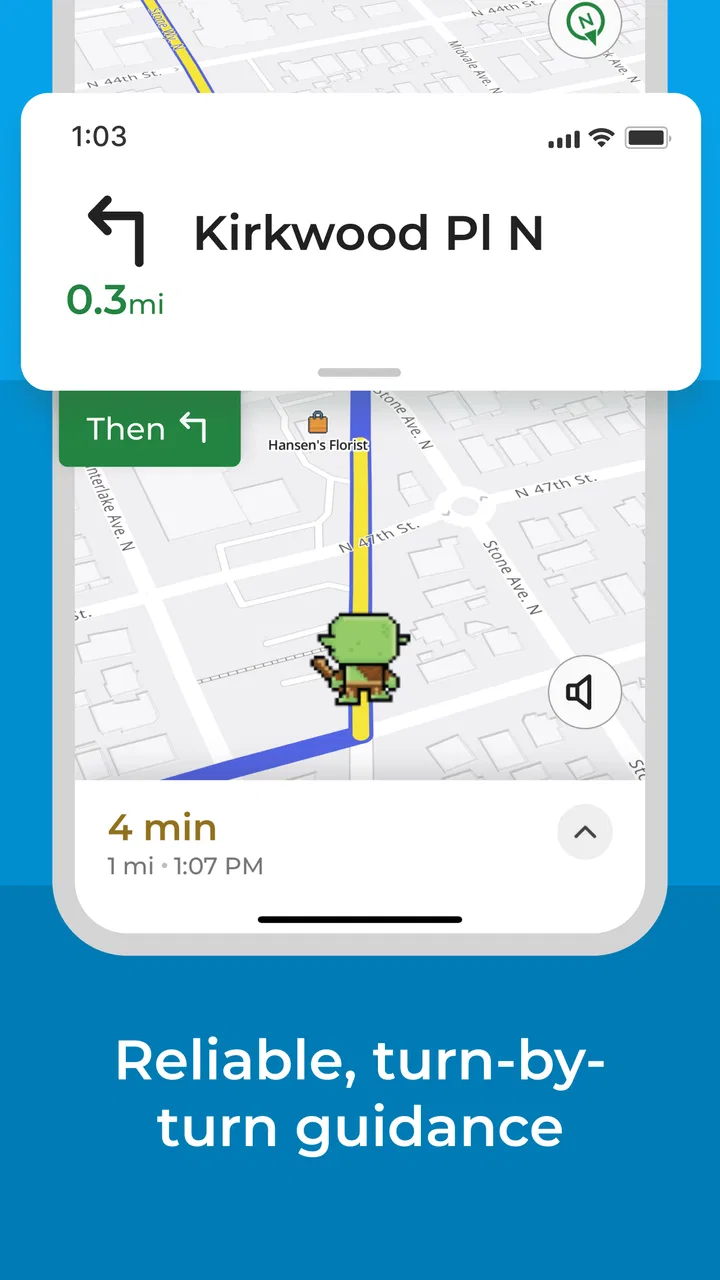
Voice navigation is especially useful when the next turn is not visible from the current road. I keep the screen available for context, but I avoid staring at it continuously. The spoken prompt should tell me what action is coming, while the map helps confirm the general direction. If the instruction sounds unexpected, I wait for a safe opportunity to verify it rather than making a sudden maneuver.
Traffic information is most valuable before the trip and at decision points, not as a reason to keep watching the display. I use it to ask whether the suggested route still looks sensible. On a familiar commute, a slower-looking road may be preferable if it avoids a difficult intersection. On an unfamiliar trip, the traffic view can help explain why the app has chosen a route that seems less direct.
Here is the everyday scenario in which I think it works best: I am leaving work to collect something from a store on the other side of town, then continuing home. I enter the store first, check the route, and notice whether the destination is on the correct side of a divided road. After completing that stop, I replace the destination with home instead of trying to improvise the second leg. That workflow reduces the chance of following an old route after the plan has changed.
Common confusion during navigation
The most common mistake is assuming that the highlighted route is a promise that every road choice will match personal preference. Navigation apps calculate a practical path, but they cannot know that I dislike a particular left turn, prefer a quieter road, or want to stop for fuel. I treat the suggested route as a strong starting point, not an instruction to surrender all judgment.
Another point of confusion is the difference between the map position and the actual direction the phone is facing. When I first leave a parking lot, the location marker may be correct while the orientation takes a moment to become useful. I avoid turning immediately based on the first visual impression. I move slowly, listen for the next instruction, and let the route become clearer.
Addresses can also be deceptive. A destination pin may be near a large building, shopping center, or complex road system rather than directly at the entrance I need. For appointments, deliveries, or events, I look at the final approach instead of assuming that arriving at the property boundary means the trip is finished. If there is a specific entrance or parking area, I add that detail to my own plan.
Rerouting deserves a realistic expectation. If I miss a turn, I want the app to help me recover, but I do not treat any navigation app as infallible. Road layouts change, temporary closures appear, and a map can lag behind reality. When a sign or traffic officer contradicts the screen, I follow the real-world instruction and reassess once safely stopped.
Battery use is another trade-off. Continuous GPS, a bright display, and spoken directions can consume more power than checking a static map. For a long drive, I use a reliable car charger and keep the phone positioned so it does not overheat in direct sunlight. This is a simple preparation step, but it prevents the frustrating situation where navigation ends because the phone runs out of power.
How it compares with familiar alternatives
MapQuest competes with the navigation tools many people already have on their phones. Google Maps is often the easier choice for users who want extensive place information, reviews, business details, and a broad travel ecosystem. Apple Maps is a natural default for iPhone owners who prefer tight integration with the Apple environment. Waze tends to appeal to drivers who value a highly community-driven view of incidents and road conditions.
My reason to choose MapQuest would be different. It feels like a dedicated route-and-map utility, which can be appealing when I want directions without making the trip feel like a social feed or a business-discovery session. Its voice guidance and traffic focus cover the needs of ordinary driving, while its long-established identity may feel familiar to people who have used MapQuest on the web.
That does not make it the best universal replacement. If I am researching a restaurant, comparing businesses, planning a complex public-transit journey, or depending heavily on live community reports, another option may fit better. MapQuest is more convincing when the central question is, “What is a sensible driving route from here to there?”
The average rating of 3.3 shows why I would test it on short trips before relying on it for an important journey. Ratings are not a complete technical verdict, but they are a useful reminder that navigation quality can vary across devices and regions. I would keep a backup plan for remote travel, unfamiliar cities, or trips where arriving on time is critical.
Useful habits beyond the first drive
One underused workflow is route checking before leaving rather than waiting for the app to solve every decision on the road. I compare the broad shape of the route with my own knowledge: where the highway begins, which side of town the destination occupies, and whether the final approach looks plausible. This takes little time and makes unexpected instructions easier to understand.
A second tip is to separate destination accuracy from route preference. If the address is wrong, changing route options will not fix the real problem. I first confirm the place, then consider whether the route suits the trip. This is particularly important for chain stores, medical buildings, hotels, and large campuses where several nearby entrances can produce very different final turns.
A third trade-off appears on multi-stop days. I prefer to finish one leg and then create the next route, rather than entering a long chain of errands and assuming the original plan will remain useful. Traffic, opening times, and unexpected delays can change the order. Rebuilding the next leg keeps the route relevant and reduces mental clutter.
For road trips, I use the app as one part of preparation. I check the first major section before departure, keep the phone powered, and pay attention to road signs. I would not rely on a navigation screen alone in areas with weak service or confusing detours. The app can guide the journey, but the driver still needs a broader understanding of where the road is going.
Who should use it, and who should skip it
I think MapQuest is a good match for someone who wants a free driving app with voice directions, map guidance, and live traffic in one familiar package. It is also worth trying if you prefer a dedicated navigation experience and do not need a large collection of travel, review, or social features.
It may suit an occasional driver better than someone who navigates professionally every day. A delivery driver or frequent traveler may need more specialized tools, stronger offline planning, richer business information, or more detailed controls than this app provides. In that situation, I would compare alternatives carefully and test every option on real routes before making it part of a work routine.
I would also skip it as my only navigation solution for a high-stakes trip until I had tested it locally. A short familiar drive reveals more than reading a feature list: it shows whether the voice timing works for me, whether the map is comfortable to read, and whether the phone handles continuous use well.
My next-step recommendation
MapQuest: Get Directions is best approached gradually. Install it, choose a destination you know, verify the address, review the proposed path, and complete a short drive with voice guidance enabled. That process gives a first-time user a reassuring answer to the important questions: does the location appear correctly, do the directions make sense, and can the app fit naturally into the way I drive?
The app is free, rated for Everyone, and currently listed at version 10.11.0. Those details make it accessible to a broad audience, but they do not remove the need for sensible preparation. I still charge the phone, avoid adjusting the route while moving, and treat signs and local instructions as more authoritative than the screen.
My final view is measured but positive. MapQuest is not the navigation choice I would recommend for every kind of travel, yet it remains a practical option for ordinary car journeys. If your priority is clear route guidance rather than a crowded travel ecosystem, it is worth testing on your next familiar drive. Give it a fair trial in a low-pressure situation, learn how its voice prompts and map view behave on your phone, and then decide whether it deserves a regular place in your driving routine.
FAQs for MapQuest: Get Directions
01What makes MapQuest different from other navigation apps?
MapQuest offers a unique blend of features that cater to users who need precise navigation and detailed directions. Unlike some other apps, MapQuest provides alternate route options, live traffic updates, and the ability to compare fuel prices along your route. Its user-friendly interface ensures that even beginners can navigate easily, making travel planning more efficient.
02Can I use MapQuest offline while traveling?
While MapQuest provides robust online functionalities, its offline capabilities are limited. Users can save routes and maps for offline use, but real-time features such as traffic updates and location searches require an internet connection. This can be a drawback when traveling in areas with poor connectivity, so it’s advisable to plan accordingly.
03Does MapQuest offer any additional features for travelers?
Yes, MapQuest offers several additional features that enhance travel experiences. These include integrated hotel booking options, restaurant reviews, and the ability to find nearby attractions. Additionally, its weather overlay feature helps users plan their trips by providing current weather conditions along the route, making it a comprehensive travel companion.
04Is MapQuest available for both Android and iOS devices?
MapQuest is available on both Android and iOS platforms, ensuring accessibility for a wide range of users. The app is regularly updated, maintaining compatibility with the latest operating systems. Users can download it for free from Google Play Store or the Apple App Store, making it a versatile tool for travelers across different devices.
05How does MapQuest handle privacy and data security?
MapQuest prioritizes user privacy and data security by employing robust encryption methods. The app collects minimal user data, primarily to enhance navigation accuracy and provide personalized services. Users have control over their data settings, allowing them to manage location sharing and other privacy preferences to ensure a secure experience.
Pros
- User-friendly interface for easy navigation.
- Real-time traffic updates improve route planning.
- Customizable route options for diverse needs.
- Accessible offline maps enhance usability.
- Integrated voice navigation aids hands-free use.
Cons
- Frequent ads may disrupt user experience.
- Limited public transport options available.
- Occasional GPS inaccuracies reported by users.
- Some features require in-app purchases.
- Battery drain can be significant on long trips.

MapQuest: Get Directions
Gallery